Showing posts with label Sustainable Sunday. Show all posts

Sunday, 21 February 2016

Sustainable Sunday: Wooden Tooth Brush

As there is so much trash in this world we try to do everything to reduce our daily amount of plastic. In this series we will show you some cheap and easy ways to do the same – try them, every step counts! :)
The one thing (nearly) everyone of us does (nearly) every day at least once is brushing our teeth. As you should change your tooth brush quarterly you collect a lot of plastic trash – including the packaging. Thus we tried an alternative: Wooden tooth brushes!

Clarissa found her brushes in the internet, I even found some at a local retailer in our city. They cost around 3-4€ (mine was 3,30€ I think) and consist of vegan and biodegradable materials.

Positive aspects 
1. The most important thing is the sustainable aspect: You neither have plastic packaging nor a tooth brush out of plastic. If you throw your brush away you can just put it into the organic waste trash bin as it is 100% biodegradable. And healthier for sure.
2. Seriously. What's the most visible difference between plastic and wooden tooth brushes? Right! The wooden ones are looking good! No childish plastic things in shitty colours anymore, but clean and simple shapes.
3. I have to admit – you have to get used to the wooden smell. But since I've grown accustomed to it I really like it: Both, smell and taste.
4. Of course there are cheaper tooth brushes but the wooden ones are really affordable and the material definitely worth the price.

Negative aspects
1. As the bristles aren't welded they can fall out – it happened with one of the holes in my tooth brush. The others stay at their place.
2. Clarissa made another negative experience: One of her brushes started to break in half, which didn't happen to mine.

Conclusion
Of course wooden tooth brushes aren't perfect and they have their minor defects but they are good-looking, good-smelling and perfectly sustainable. So try it, maybe it's the perfect alternative for you!
Credits:
Idea: Clarissa Kober and Diana Ranegger; Words, Photographs: Diana Ranegger
Read More

Sunday, 15 February 2015

Sustainable Sunday: Homemade Avocado Mask

Ich hatte mal eine Phase – vor circa sechs, sieben Jahren – in der ich mir eingebildet habe, dass ich jedes nur erdenkliche "Beautyprodukt" bräuchte, das auf dem Pseudo-Biomarkt erhältlich war (dabei schreibe ich ganz bewusst "Pseudo", da die meisten dieser Dinge zwar ein "Natur" im Namen hatten, ansonsten aber wohl alles andere als natürlich waren). Nicht Make-Up, Puder oder Wimperntusche, nein, vom Schminken hielt ich nie viel. Aber Handcremes, Fußerfrischungsgels und vor allem Gesichtsmasken. Je mehr ich davon besaß, desto besser. Die Schublade war voll.

Und, was soll ich sagen? Das meiste davon besitze ich noch heute, da ich nur ein Viertel davon je verwendet habe. 
Um dieser Verschwendung und der ganzen Chemie, die sich in diesen Produkten wahrscheinlich versteckt hält, auszuweichen, mache ich mir diverse Masken und Peelings jetzt ganz einfach selber. Ganz ohne Chemie. Und vor allem ohne Mikroplastik.

I once had a quirk: I had to have all the "natural" beauty products (well, I'm sure they weren't as natural as the commercial stated) out there – I had a whole drawer full. And I still have it today, because I needed just about 1/4 of it. A drawer full of hand lotions, foot gels and face masks.
So today I make them by myself. It's much more sustainable and doesn't contain all that chemistry. Goodbye, micro plastic.
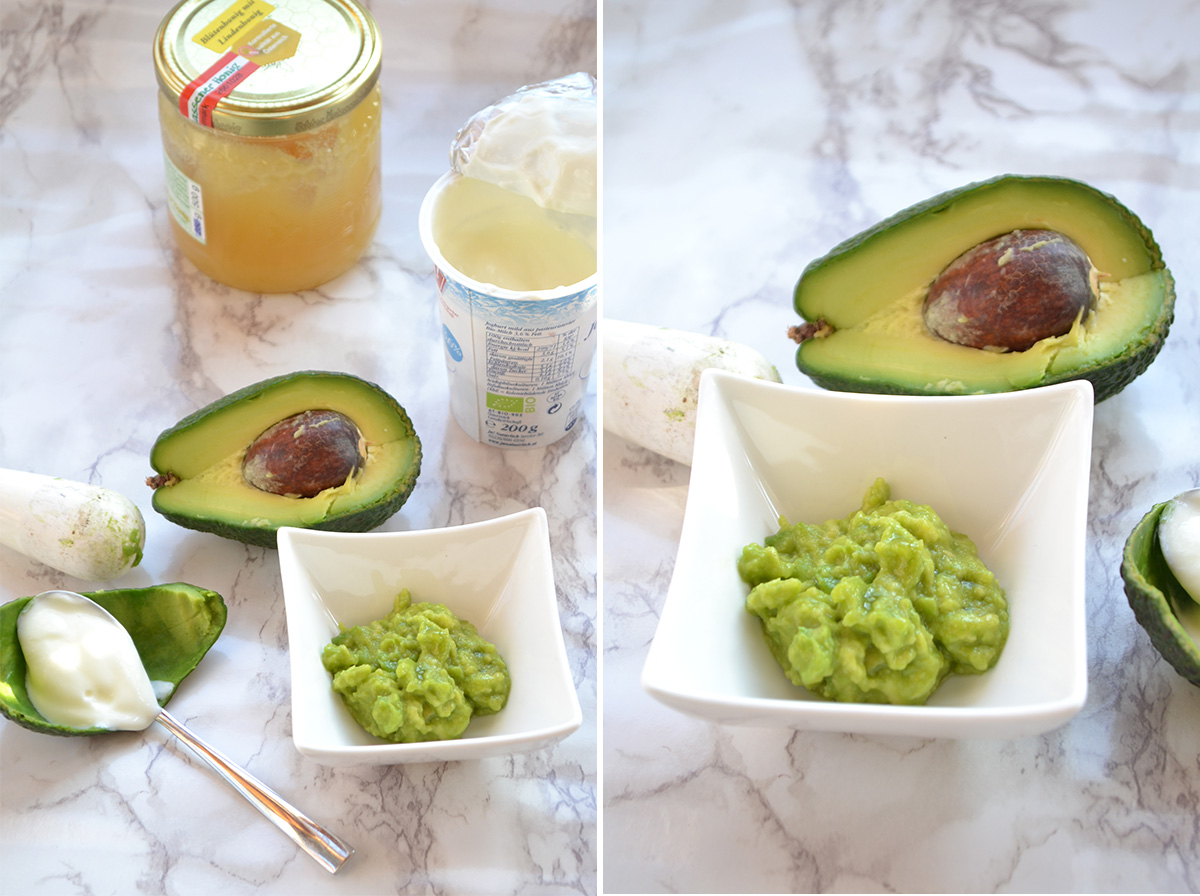
Die Maske ist perfekt für raue, trockene Haut. Ich hab sie vor allem im Gesicht verwendet, bin mir aber sicher, dass sie auch für Hände und Füße perfekt geeignet ist! (Da fällt mir ein, es ist ja noch ein kleines bisschen übrig und meine Hände wieder einmal rau wie Schleifpapier. Das sollte ich wohl ausprobieren... ;)

The mask is perfect for dry skin. I used it in my face, but I'm sure you can also use it for rough hands or feet! (Oh, I think I should try this now. I still have something and my hands feel like sandpaper... ;)

Das brauchst du (für 2-3 Anwendungen): 

* 1/4 Avocado
* 1/2 TL Honig
* 1 TL Olivenöl 

* 1/4 Avocado
* 1/2 tsp Honey
* 1 tsp Olive Oil

So wird's gemacht: 

1. Zerstampfe das Fleisch der Avocado mit einem Mörser. Alternativ kannst du es auch mit einer Gabel klein zerdrücken. Füge nun die restlichen Zutaten hinzu und vermische alles gut. Wenn du willst, kannst du auch noch einen Teelöffel Naturjoghurt untermischen – das kühlt extra und gibt Frische :)
2. Verteile die Maske nun auf dein Gesicht und lasse sie für zehn Minuten einwirken. Denke dabei an etwas Schönes ;)
3. Wasche die Maske mit viel lauwarmen Wasser ab und genieße die neue Frische!

1. Pound the avocado pulp. Add all the other ingredients. If you want, you can also add a teaspoon of yogurt, extra cool and fresh!
2. Spread the mask on your face and leave it for about ten minutes. Think of something beautiful ;)
3. Wash it away with warm water and enjoy the new freshness!
Credits:
Idea, Text, Photos: Diana Ranegger
Read More

Sunday, 1 February 2015

Sustainable Sunday: Sweatshop

Sie sind ja die letzten Tage und Wochen wie ein Virus durch das Internet gegeistert – für alle, die sie aber noch nicht gesehen haben, wollte ich sie hier noch einmal posten.
Die Rede ist von den kurzen Episoden der norwegischen Realityshow "Sweatshop". Aufgeteilt in fünf einzelne Videos, geht es hier um drei norwegische Blogger und Bloggerinnen, die nach Kambodscha fahren, um zu sehen, wie die Kleidung, die sie hier um einen Spottpreis kaufen, produziert wird. (Und ja, das ist alles echt, soweit ich mitbekommen habe.)
Ich hab mir die Folgen gleich alle auf einmal angesehen (war eine interessante Alternative zum Lernen für meine Prüfung) und hab mir gedacht, dass ich sie unbedingt nächsten Sonntag (also heute) posten muss. Ich werde sie jetzt einfach mal unkommentiert lassen, da ich schon viel zu viele Meinungen darüber gelesen habe – meine wäre wahrscheinlich einfach nur ein Post in anderen Worten. Darum: Seht es euch einfach selbst an!

Und nein, keine Angst. Wer sich vor schrecklichen Bildern fürchtet, braucht sich keine Sorgen zu machen. Blut wird hier nicht vergossen. Nur Tränen....
Hier geht's zu den Videos.

You could find them everywhere in the internet the last days and weeks – for all, who haven't seen them though, I will post them here again.
I talk about the short episodes of the Norwegian reality show "Sweatshop". In the five parts of the show you can see three Norwegian bloggers that travel to Cambodia in order to see how their clothes get produced (and yes, to my knowledge it's all real).
I've watched the whole series at once (it was an interesting alternative to learning for my exams) and I knew that I have to post them sext Sunday (so today). I won't comment on them, because I have read too many opinions about it. So: Just watch them yourself!

And no, never fear. If you are afraid of awful pictures, don't worry. There's no blod to be shed. Just tears...
Click here for the videos.
Read More

Sunday, 25 January 2015

Sustainable Sunday: Yes, I am guilty

Yes, I was the one who ate the banana today in the morning, together with the two kiwis and the orange.
I was the one who bought frozen berries for making a blueberry smoothie with coconut milk.
I was also the one who killed the pomegranate to enjoy the sweet taste of the south.
Yes, I am guilty.

Always talking about what you should do and what you shouldn't do. Everyone does it, we do it. But today I want to start right here. With me. 

I don't eat meat or fish and I refuse cakes with gelatin. I'm thinking a lot about what I eat. Especially where my food comes from, if it is organic or not. I'm sure that I pay more for my food than many of my friends do just for getting quality. And I'm trying to help other people to do so, with this blog for example.

But still, I want to be honest. I'm not a saint, nobody is. This recent post from DariaDaria made me think and gave me the idea – no, the push – for this post. So I wanted to tell the truth and to make it clear: 
Also I buy sometimes electronic stuff produced in China. Also I have pants for twenty Euros and bras for ten. Also I eat bananas or drink orange juice. 

What I want to say is that I don't write this post or this entire blog because I am good and there is so much bad outside. I know that I could do so much more for "a better world and planet" and that I have blotted my copybook.

BUT. I made a start for me. And I want to encourage you to do the same. To think of where the stuff you eat comes from. To reduce your buying habits a little bit and start getting more second hand or fair-trade. These are just little steps, but if everyone does them, they grow and grow.

We can do it together :)
Credits:
Idea, Text, Photos: Diana Ranegger
Read More

Sunday, 18 January 2015

Sustainable Sunday: Let it grow

Du willst deinem Zimmer neues Leben einhauchen? Sieht es tot und leblos aus? Das allerwichtigste für mich in einer Wohnung sind Pflanzen. Je grüner, desto besser, so lautet die Devise, egal wie viel Platz dann noch für anderen Zeug bleibt. Wenn ich könnte, würde ich alles bepflanzen; alte Schuhe, Tassen, Weingläser,... Eine kleine Inspiration.

You want to breath new life into your flat? It seems dead and lifeless? The most important thing for me in a room are plants. The greener the better, no matter how much place left for other stuff. If I could I would crop everything, no matter if it's an old shoe or a cup for tea. A little inspiration.
Warum Pflanzen pflanzen? Die stillen, grünen Mitbewohner erfreuen einen nicht nur mit einem hübschen Erscheinungsbild, sondern sind auch noch 1A-Luftverbesserer! Dagegen sind Parfums und Raumdüfte nichts (und nebenbei auch noch ziemlich ungesund. Außerdem stinken sie, aber ja, das ist eine andere Geschichte).
Pflanzen hingegen sind meist geruchsneutral und sorgen trotzdem für bessere Luft im Schlafzimmer. Wenn man es richtig macht, erfreut man sich auch recht lange an dem hübschen Grün. 

Why to plant plants? The silent, green flat mates aren't only beautiful, but also wonderful air freshener! Better than any perfumes and air deodorants (also healthier and they smell better). If you do it right, plants have also a long life time.
Es ist ziemlich einfach, eine Blume zu pflanzen. Man gibt ein wenig Erde in eine Tasse, setzt sie darauf und füllt mit Erde auf.
Um ehrlich zu sein: Das "Schwierige" ist es, die Pflanze am Leben zu halten. Jeder, der das schon einmal probiert hat, wird das wissen.

Pflanzen brauchen Licht und Wasser. Aber nicht zu viel Wasser, sonst ertrinken sie und beginnen zu faulen. Darum am besten immer gleich Töpfe mit Löchern am Boden kaufen, damit das Wasser schön abrinnen kann. Oder Löcher in die Töpfe bohren, wenn einem das lieber ist.
Wenn das aus irgendeinem Grund nicht möglich ist, muss du immer wahnsinnig aufpassen, dass die Erde nicht mit Wasser übersättigt wird. Es ist wie immer: Mehr bedeutet nicht zwangsläufig besser und zu viel ist sowieso schlecht.

It's easy to plant something. You just have to put some soil in a cup, put the crop on it and fill it up with soil. 
To be honest: The most difficult thing is to keep the plant alive. Everyone who tried it, will know that. 

Plants need light and water. But not too much water, otherwise it may start to rot. It would be best to use pots with holes on the bottom – or to bore one by yourself so that excessive water can go away. If you can't do that for any reason, you have to be super careful to not oversaturate the soil with water. It's the same as always: More is not better, too much is bad. 
Die beste Methode, Pflanzen am Leben zu erhalten ist, jeden Tag nachzusehen, ob die Erde feucht oder trocken ist. Ist sie trocken, gieße sie ein wenig – aber sei vorsichtig, "ein wenig" heißt ein wenig. Es ist besser, die Pflanze am nächsten Tag wieder zu gießen, als sie zu ertränken. Und denke daran: Pflanzen sind Lebewesen. Wie Tiere. Kein Tier überlebt drei Wochen Urlaub alleine, egal wie viel Wasser du ihnen im Voraus gegeben hast. 

Der meiner Meinung nach wichtigste Tipp ist allerdings: Nicht traurig sein, wenn es mal nicht klappt. Manchmal sterben Pflanzen, auch ohne ersichtlichen Grund. Und sollte der Grund doch ersichtlich gewesen sein: Beim nächsten Mal besser machen und nicht aufgeben. 

The best method to keep your plants alive is to feel if the soil is dry or wet. Is it dry, add a little bit water – but be careful, if I say "a little bit", I mean a little bit. It's better to water it the next day again than to let it drown. And remember: Plants are creatures, they live. Like animals. No animal survives three weeks of holidays alone, no matter how much water you gave them before. 

The most important tip is still: Don't be sad if something goes wrong. Sometimes plants die, sometimes even without a visible reason. If there is a visible reason: Do it better next time and don't give up. 
Credits:
Idea, Text, Photos: Diana Ranegger
Read More

Sunday, 11 January 2015

Sustainable Sunday: Daily Tipps for Saving Energy

Einen schönen Sonntag euch allen! Ich hoffe, es geht euch nicht wie mir, die schon seit Tagen mit Fieber und jeder Menge Husten im Bett verbringt. Zum Glück war dieser Post schon zuvor mehr oder weniger fertig ;)
Die meisten von euch werden diese Fakten kennen – aber nicht jeder berücksichtigt sie im täglichen Leben. Wir sollten dies JETZT ändern! Zehn Tipps, wie man Energie sparen kann, ohne an Lebensqualität einsparen zu müssen. Nicht nur für die Umwelt, auch für deine Geldtasche.

Happy Sunday! I hope you are feeling better than me, who lies with a temperature in bed for four days now. Luckily this post has been nearly finished before ;)
Many of you will know these facts – but not everyone consider them when living their daily life. We could change that NOW! Ten tips for saving energy without losing quality of life. Not just for environment, also for your wallet. (Scroll down for the English version)
#1 Schalte das Licht, das du gerade nicht brauchst, aus.
Ich weiß, das scheint sehr offensichtlich. Aber es gibt immer wieder Leute die es nicht machen, einfach nur, weil sie es vergessen. Darum hier eine Erinnerung.

#2 Schalte alle Kippschalter aus.
Auch wenn keine Geräte an den Verteilersteckern hängen – sie brauchen trotzdem Strom und der summiert sich. Also besser ausschalten.

#3 Schalte dein Internet, wenn du nicht zu Hause bist und über Nacht aus.
Es spart nicht nur Strom; die Strahlen sind auch nicht sonderlich gut für deinen Körper.

#4 Kaufe sparsame Geräte (am besten A+++)
Wenn du neues Zeug kaufst, schau dir das Energieverbrauchsetikett an und kaufe nur Dinge mit A++ oder besser.

#5 Wasche dein Geschirr im Geschirrspüler – und warte, bis er voll ist.
Kaum zu glauben, aber wahr ;) Es sind tatsächlich sparender, als die gleiche Menge an Geschirr mit der Hand abzuwaschen. Ein voller Geschirrspüler spart mehr als 50% der Wassermenge – und somit auch des Warmwassers.

#6 Schließe den Kühlschrank so früh wie möglich.
Dass man den Kühlschrank aufmachen muss, ist wohl unvermeidbar. Aber wenn du gefunden hast, was du gesucht hast, schließe die Tür! Ganz egal, ob du in einer Minute wieder hinein musst.

#7 Koche dein Zeug in Pfannen und Töpfen, die mindestens so groß sind, wie die Kochplatte.
Wenn die Platte auch nur drei Zentimeter größer ist, verschwendest du 30% der Energie!

#8 Wasche deine Kleidung bei 30° Celsius.
Wenn du nicht gerade Geschirrtücher, Unterwäsche oder Handtücher wascht, reichen 30° Celsius völlig aus. 95° verwenden wir sowieso nie, 60° nur in Ausnahmefällen. So ist es viel sparsamer und besser für die Stoffe!

#9 Finger weg von Trocknern!
Kleidung trocknet genauso gut  an der Luft. Deine Haare übrigens auch. 

#10 Versuche, dein Handy so wenig wie möglich aufzuladen.
Es ist Abend und dein Handy hat noch 40% Akku? Gut! Schalte es aus und spare die Energie für morgen!


Habt ihr Tipps, die wir hier vielleicht nicht genannt haben? Dann schreibt sie in die Kommentare – wir würden uns sehr freuen! :)
#1 Turn off all the light you don't need in your house. 
I know, this one is obvious, but there are still so many people who don't do it, just because they forget it. So keep it in mind and think of it all day!

#2 Turn off all the rocker switches. 
Even if there is no electrical device plugged in – it still wastes a lot of energy! So turn them off.

#3 Turn off your internet if you are not at home and when you are sleeping.
It's not only for saving energy; also the rays aren't very healthy. 

#4 Buy economical gadgets (best A+++)
If you buy new stuff, have a look at the energy label and buy the thing with the A++ or better.

#5 Wash your dishes in a dish washer – and wait until it's full.
Yeah, it's actually more economical than washing with hands. A full dish washer saves more than 50% water – so also warm water.

#6 Close your fridge as soon as possible.
Opening the fridge is unavoidable, of course. But when you have, what you were looking for, close the door! No matter if you will open it again in a minute.

#7 Cook your stuff in pans that are at least as large as the cooking plate.
If the plate is just three centimeters larger, you waste 30% of the energy!

#8 Wash your clothes at 30° Celcius. 
If not towels or underwear – wash your stuff at 30° Celcius. It's much more economical and even better for all the fabrics!

#9 Leave the dryers out. 
Clothes also dry with normal air perfectly. By the way, your hair, too.

#10 Try to charge your mobile as little as possible.
It's evening and your phone still has 40% battery? Good! Switch it off and save it for tomorrow!


Do YOU have any own tips for us? Feel free to write them in the comments. We'd love to hear them!
Credits:
Text, Idea, Photos: Diana Ranegger
Read More

Sunday, 28 December 2014

Sustainable Sunday: Homemade Dry Shampoo

Dass tägliches Haarewaschen nicht das Beste sein soll, habt ihr gewiss schon tausendmal gehört oder gelesen. Trotzdem ist es kein schönes Gefühl, mit öligen Haaren in die Öffentlichkeit zu gehen. Was also tun? Richtig. Wir benützen Trockenshampoos. Aber nicht etwa diese grausigen Sprühflaschen, die unter Druck stehen und uns bei jeder Anwendung den Hals verätzen – nebenbei noch Aluminium beinhalten und richtig teuer sind. Nein, wir machen uns unser Shampoo selbst! Und das in weniger als einer Minute.

I'm sure you've read and heart it more than a thousand times now: Daily hair washing is not the healthiest thing. But oily hair in public is also not the best feeling. So, what should we do? Right, we use dry shampoo. But not these awful aerosol cans that burn our throats when using them (these are expensive, by the way, and contain aluminium). No, we make them by ourselves! Within less than one minute.
Das wird gebraucht:

Für helles Haar: 
* Maisstärke

Für dunkles Haar:

* Maisstärke
* Kakaopulver
* Eventuell etwas Zimt

For fair hair:

* Corn Starch

For dark hair: 

* Corn Starch
* Cocoa
* Cinnamon, if you want

So wird's gemacht:

1. Hast du helles Haar, kannst du diesen Schritt überspringen. Alle Dunkelhaarigen unter euch: Vermischt die Maisstärke und das Kakaopulver in einem Glas miteinander. Am besten nehmt ihr ein Glas mit Deckel, so könnt ihr das Trockenshampoo nicht nur gut lagern, sondern zum Vermischen auch gleich schütteln. Je nach Haarfarbe variiert das Verhältnis von Kakao und Maisstärke (Clarissa zum Beispiel, nimmt sowieso nur Kakao). Wenn du es gerne weihnachtlich hast, kannst du etwas Zimt beifügen.
2. Trage das Trockenshampoo mit einem sauberen Make-Up-Pinsel auf die öligen Haarstellen auf und "verpinsle" es ein wenig. Danach Haare mit den Händen auflockern, ein wenig kopfüber ausschütteln und schon bist du fertig und wieder ausgehbereit! :)

1. If you have fair hair, just skip this part. All of you with dark hair: Mix corn starch and cocoa in a glass. I'd recommend to take a jar with lid: Your shampoo will last longer and you can shake it instead of stirring it. Depending on your actual hair colour, take more cocoa or more corn starch (Clarissa, for example, uses only cocoa). If you like it Christmassy, put some cinnamon it it.
2. Use the dry shampoo with a make-up-brush on the oily parts of your hair and spread it a little bit. Then use your hands for tousling through your hair until you can't see the shampoo anymore. Finished! :)
Credits: 
Idea, Photos and Text: Diana Ranegger
Read More

Sunday, 21 December 2014

Sustainable Sunday: Everyday Life

Wenn ich zählen würde, an wie vielen Tagen ich es NICHT verwende – ich würde wahrscheinlich auf höchstens fünfzehn Tage im Jahr kommen. Und das wären Tage, an denen ich keinen Internetanschluss habe, weil in meinem Hostel in Spanien oder Frankreich kein WLAN ist. 

Da bin ich wohl nicht die Einzige.

Zwei Leute diskutieren miteinander, ob Bangkok die Hauptstadt von Thailand ist, oder eben nicht. Sie überlegen nicht lange und googlen es.
Ein Junge sieht eine Serie im Fernsehen und kennt den Hauptdarsteller. Doch von welchem Film? Oh, er googlet es.
Ein Mädchen liest ein Buch, das ihr hervorragend gefällt und würde gerne ein neues vom selben Autor lesen. Welches? Ihr wisst es sicher schon – sie googlet es.
Ich mache Palatschinken und hab vergessen, wie viel Mehl ich dafür brauche. Was werde ich also tun? Ja, ich ecosiare es. 

Ecosiaren? Ist das überhaupt ein Verb?

Ehrlich gesagt: Nein. Aber wenn Google ein eigenes Verb dafür hat, benutzt zu werden, warum dann nicht auch Ecosia? Wohl, weil noch zu wenig Menschen via Ecosia ihre Suchanfragen senden. Das müssen wir ändern! Denn Ecosia bringt nicht nur ausgezeichnete Ergebnisse, sondern ist noch dazu eine Suchmaschine, die uns dabei hilft, Mutter Erde etwas Gutes zu tun.
Wie das funktioniert? 
Kurz gesagt, spendet Ecosia 80% des Geldes, das es durch Werbung einnimmt, an ein Regenwaldaufforstungsprojekt. Mit jeder neuen Suche, kann man hier also gratis Bäume pflanzen.
Lang gesagt, kann man dies auch hier nachlesen und sich ein eigenes Bild davon machen: https://www.ecosia.org/what. Die Seite erklärt das ganze Projekt wunderbar einfach und anschaulich (sogar mit einem Video).

Also, suchst du noch oder pflanzt du schon? 

If I counted all the days in one year when I don’t use this thing I’d come to a maximum rage of 15 days. And these are days when I don’t have internet access because there is no wifi in my hostel in France or Spain.

Actually I’m not the only one.

Two people are talking about whether Bangkok is the capital city of Thailand or not. Well, let’s google it.
A guy is watching a series with an actress he knows for sure. But from which film? Oh, let’s google it.
A girl is reading a book she pretty enjoys and wants to read another one from the same author. Which one? You know, let’s google it.
I’m cooking pancakes and forgot the amount of flour I have to take. What will I do? Yeah, I’ll ecosia it.

Ecosia? Is that even a verb?

To be honest, I just made it up. But if Google has a verb for being used, why not Ecosia? Because it’s not that popular – but we have to change that. By using Ecosia as a search engine you do not only get great results: You also help saving our planet.
How it works?
In short, Ecosia donates 80% of the money they make through ads to a rainforest project. So with every time searching for something you help planting trees.
In long, you can read and watch much more about it on https://www.ecosia.org/what. It’s a pretty nice page that explains the whole project in a wonderful, but simple way.

So, are YOU still searching or already planting? 

Credits: 
Idea and Test: Diana Ranegger | Photos: www.ecosia.org
Read More